



Primary 5 Math: A Holiday Plan Before the PSLE Year
The end of Primary 5 is a good moment to take stock. Primary 5 Math lays most of the groundwork for the PSLE, and Primary 6 moves quickly from new topics to revision and timed practice. This guide explains how the PSLE Mathematics paper is set out, which topics have moved in the current syllabus, and a light four-week December plan that leaves plenty of time to rest.
Primary 5 Math covers much of the groundwork for the PSLE, including fractions, decimals, percentage, area and volume. Over the December holidays, a light plan of 20 to 30 minutes a day in the last three weeks, focused on fractions, percentage and word problems, helps most children start Primary 6 with confidence. Elyspire Tuition offers one-to-one PSLE Maths tuition at home or online in Singapore.
What Changes After Primary 5 Math
Primary 6 is a shorter year for new content. Schools usually teach the remaining Primary 6 topics in the first half of the year and then move to revision, school preliminary examinations and timed papers before the PSLE written papers.
That means the Primary 5 Math topics are not finished when Primary 5 ends. They come back in almost every PSLE question, often mixed with Primary 6 work in a single problem.
How the PSLE Maths Paper Is Set Out
Under the SEAB PSLE Mathematics syllabus for 2026, the examination has two papers of 50 marks each, taken on the same day. Paper 1 lasts 1 hour 10 minutes and does not allow a calculator. Paper 2 lasts 1 hour 20 minutes and allows a calculator.
Paper 1 has multiple-choice and short-answer questions. Paper 2 has short-answer questions and longer structured questions worth 3 to 5 marks each, where clear working earns method marks.
Primary 5 Math Topics That Carry Into the PSLE
Fractions are the biggest thread. Fractions as division and the four operations on fractions appear again in ratio, percentage and long word problems in Primary 6.
Decimals, percentage, rate, area of triangles, volume of cubes and cuboids, and angles in triangles and four-sided figures also carry forward. A child who is steady with these in Primary 5 has far less to relearn in a busy Primary 6 year.
Topics That Moved in the Current Syllabus

The MOE Primary Mathematics syllabus, which started with the 2021 Primary 1 cohort who sit the PSLE in 2026, moved several topics between levels. Ratio and average are taught in Primary 6, pie charts and nets in Primary 4, and speed is no longer part of the Primary syllabus; it is now taught in Secondary 1.
Older assessment books and past papers may still include speed questions or place ratio in Primary 5, so it helps to check the year of any practice material before your child uses it.
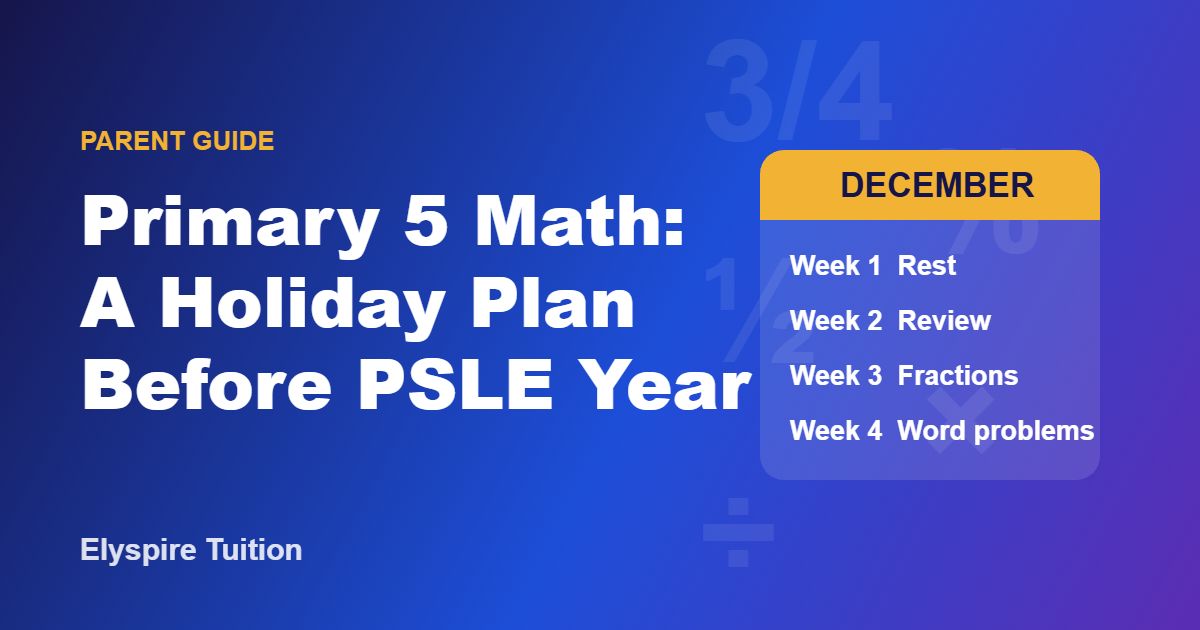
Weeks 1 and 2: Rest and a Gentle Review
The first two weeks of the holidays are for rest. Children who start Primary 6 rested tend to keep up better through a long year.
In week 2, a short review of the Primary 5 end-of-year paper is enough. Sort the mistakes into careless slips, gaps in a topic and questions that were left blank, because each needs a different fix.
Weeks 3 and 4: Fractions, Percentage and Word Problems

Week 3 focuses on fractions and percentage, the two topics that link most Primary 6 work. Ten to fifteen questions a day, with each step written out, is plenty.
Week 4 turns to word problems. Model drawing, listing and working backwards are the methods students use most often at the PSLE, and practising one method a day builds confidence for longer questions.
Paper 1 Habits: Working Without a Calculator
Because Paper 1 does not allow a calculator, quick and accurate mental work matters. Short daily practice with multiplication facts, fraction and decimal conversions and simple percentages saves time in the examination.
Checking is a habit too. Teach your child to re-read the question, check the units and look at whether the answer makes sense before moving on.
Signs Your Child May Need Extra Support
Some signs suggest that extra support before Primary 6 would help: marks that dropped through Primary 5, many blank answers in longer questions, confusion with fractions, or a child who avoids Mathematics homework.
Early help works best. A gap in fractions closed in December is far easier than one discovered after the Primary 6 mid-year examination, when revision has already started.
How Elyspire Tuition Supports Primary 6 Students
At Elyspire Tuition, our certified, experienced and patient tutors teach one-to-one, at home or online, from Primary through Secondary. For Primary 5 and Primary 6 Mathematics, we focus on clear explanations, systematic practice and patient guidance, and we track each student’s progress across the year.
Our PSLE Maths tuition prepares students for both papers, and our Primary tuition covers other subjects too. WhatsApp us at +65 9684 2263 to talk about your child’s needs and find a tutor who suits them.
Frequently Asked Questions

Is speed still tested in the PSLE?
No. Under the current syllabus, speed has moved to Secondary 1 and is no longer tested at the PSLE from 2026. Older practice papers may still include speed questions.
Is ratio taught in Primary 5 or Primary 6?
Under the current Primary Mathematics syllabus, ratio is taught in Primary 6, together with average. Older assessment books may still place ratio in Primary 5.
Can my child use a calculator in the PSLE Maths paper?
Only in Paper 2. Paper 1 does not allow a calculator, so mental calculation and accurate working by hand matter.
How much should my child study during the December holidays?
A light plan works best: rest first, then 20 to 30 minutes a day in the last three weeks, focused on fractions, percentage and word problems.