

PSLE Past Year Papers: How to Use Them Well
PSLE past year papers are one of the most useful revision tools a Primary 6 family has, but only when they are used with a plan. Doing paper after paper without reviewing mistakes rarely moves marks. This guide explains where official papers come from, why the syllabus year matters, and how to turn each paper into real progress.
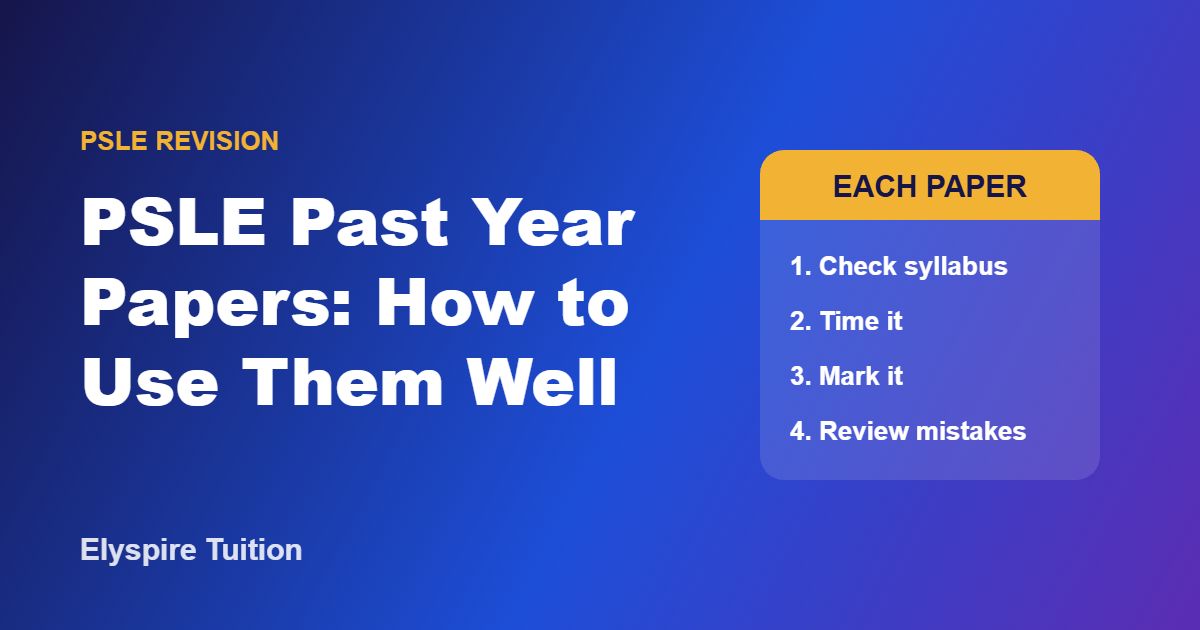
Official PSLE past year papers are sold through SEAB’s appointed distributors, Shing Lee Publishers and Educational Publishing House. Check that each paper matches the current syllabus, start full papers once most topics have been taught, do them under exam timing, and spend as long reviewing mistakes as doing the paper. Elyspire Tuition offers one-to-one PSLE tuition at home or online in Singapore.
Where Official PSLE Past Year Papers Come From
The Singapore Examinations and Assessment Board lists its appointed distributors of past years’ question papers. For the PSLE, these are Shing Lee Publishers and Educational Publishing House, and their compilations are sold in bookshops and online.
Many websites also share school preliminary papers. These are useful extra practice, but they are set by individual schools, so their difficulty and format can differ from the national examination.
Check the Syllabus Year Before You Start
Syllabuses change, and older papers do not always match what your child will sit. In Mathematics, the current MOE Primary Mathematics syllabus no longer includes speed at the Primary level, so speed questions in older papers can be skipped.
The paper format matters too. Under the SEAB PSLE Mathematics syllabus for 2026, Paper 1 lasts 1 hour 10 minutes without a calculator and Paper 2 lasts 1 hour 20 minutes with a calculator, each worth 50 marks. Practising to the current timings builds the right pace.
When to Start Using Past Year Papers
Full past year papers work best once most of the syllabus has been taught, which for most children is the second half of Primary 6. Before that, a full paper mixes in topics your child has not learned yet, which can knock confidence.
Earlier in the year, single sections or topic-based questions from past papers are a better fit. They give your child a feel for the examination style without the pressure of a full paper.
Doing a Paper Under Exam Conditions

A past year paper teaches the most when it feels like the real thing. That means a quiet table, a timer set to the official duration, no notes, and calculator use only where the paper allows it.
Afterwards, ask your child how the time went: which section took too long, and where they rushed. Pacing is a skill of its own, and past papers are the best place to practise it.
Marking and Reviewing Mistakes
The review is where marks are won. Sort each mistake into one of three groups: a careless slip, a gap in a topic, or a question that was not understood. Each group needs a different fix, from a checking habit to re-teaching a topic.
A mistakes notebook helps a great deal. Writing the correct method beside each error, and revisiting the notebook before the next paper, stops the same mistake from returning.
Spacing Papers Through the PSLE Year

Quality beats quantity. A steady rhythm of papers with a thorough review in between does more than a large pile of papers done quickly.
Spreading papers across subjects also helps. Rotating Mathematics, English, Science and Mother Tongue keeps every subject fresh and avoids a last-minute rush in any one of them.
Mixing Past Papers With Topical Practice
Past papers show where the gaps are; topical practice closes them. When a review shows the same topic causing trouble, a short set of questions on just that topic before the next full paper works better than moving straight on.
School examination papers, past year papers and topical work each play a part. Together they give your child both breadth across the syllabus and depth in weaker areas.
Signs Past Papers Are Not Helping
Some signs suggest that past papers alone are not enough: marks that stay flat across several papers, the same types of mistakes appearing again and again, or a child who dreads every practice session.
At that point, slowing down usually helps more than adding papers. Fewer papers with deeper review, or focused help on the topics behind the mistakes, can restart progress.
How Elyspire Tuition Supports PSLE Students
At Elyspire Tuition, our certified, experienced and patient tutors teach one-to-one, at home or online, from Primary through Secondary. For PSLE revision, we go through past year papers with your child, explain each mistake clearly, and build systematic practice on the topics that need it, while tracking progress across the year.
Our PSLE Maths tuition, PSLE English tuition and PSLE Science tuition prepare students for every paper. WhatsApp us at +65 9684 2263 to talk about your child’s needs and find a tutor who suits them.
Frequently Asked Questions

Where can I buy official PSLE past year papers?
SEAB lists Shing Lee Publishers and Educational Publishing House as the appointed distributors of past years’ PSLE question papers, and their compilations are sold in bookshops and online.
Are older PSLE papers still useful?
Yes, with care. Check each paper against the current syllabus; for example, speed is no longer part of the Primary Mathematics syllabus, so older speed questions can be skipped.
When should my child start doing full past year papers?
Full papers work best once most of the syllabus has been taught, usually in the second half of Primary 6. Earlier, topic-based questions from past papers are a better fit.
How long is each PSLE Maths paper?
Under SEAB’s 2026 syllabus, Paper 1 lasts 1 hour 10 minutes without a calculator and Paper 2 lasts 1 hour 20 minutes with a calculator, each worth 50 marks.