




PSLE English Composition: How It Is Marked and How to Score
The PSLE English composition is the single biggest written task in the English examination. Many children can write a good story at home but find it hard to plan, choose a picture and finish well in the time allowed. This guide explains how the writing paper is set out, what examiners assess, and simple habits that help your child write a clear, well-organised composition.

In the 2026 PSLE, Paper 1 (Writing) lasts 1 hour 10 minutes and has two parts: Situational Writing for 14 marks and Continuous Writing for 36 marks. The PSLE English composition must be at least 150 words and based on at least one of three pictures. Examiners assess how well the writing suits its purpose, how accurate the language is, and how relevant and well organised the ideas are. Elyspire Tuition offers one-to-one PSLE English tuition at home or online in Singapore.
How the PSLE English Writing Paper Is Set Out
Under the SEAB PSLE English Language syllabus for 2026, Paper 1 (Writing) lasts 1 hour 10 minutes and makes up 25% of the English Language grade. It has two parts: Situational Writing, worth 14 marks, and Continuous Writing, worth 36 marks.
Both parts are written in the same 70 minutes, so your child decides how to divide the time. The composition carries more marks, but a rushed Situational Writing piece can lose easy marks.
What Examiners Look For in a Composition
SEAB sets two assessment objectives for the writing paper. The first is writing effectively to suit purpose, audience and context, with accurate and appropriate vocabulary, grammar, punctuation and spelling. The second is generating and selecting relevant ideas, and organising and expressing them in a coherent and cohesive way.
In practice, that means a strong PSLE English composition answers the topic, tells a clear story from beginning to end, and uses language that is accurate first and descriptive second.

Using the Three Pictures Well
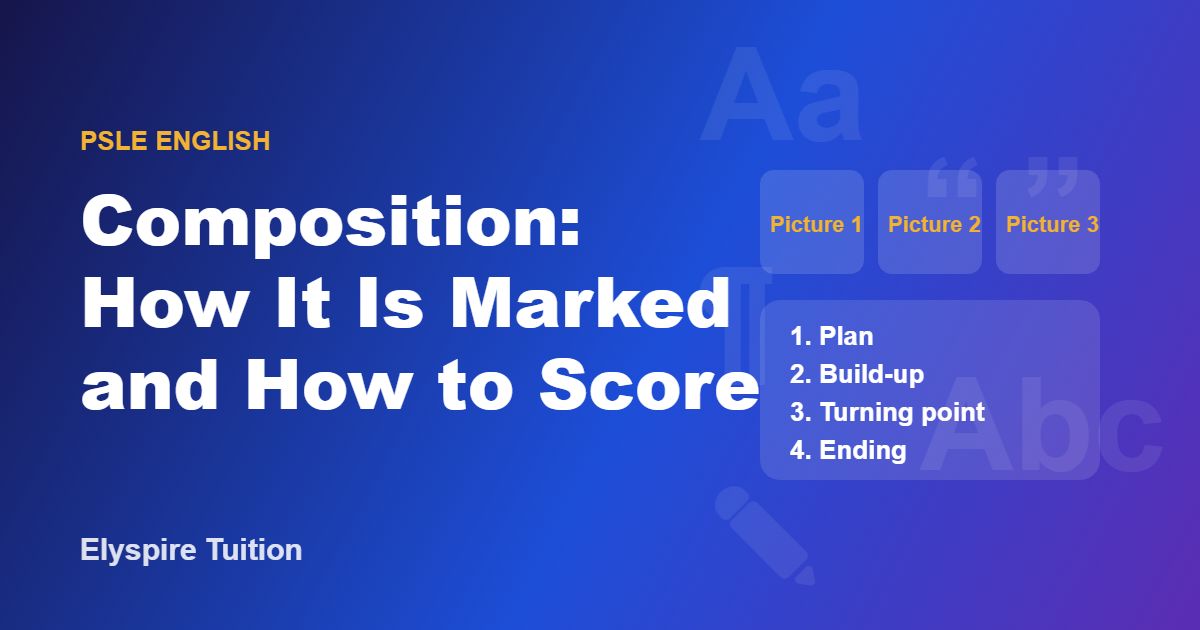
The composition topic comes with three pictures that offer different angles on the topic, and the story must be based on at least one of them. The pictures are there to help, not to limit.
A good habit is to look at all three pictures, then pick the one that suggests a story your child can tell well, with a clear problem and a satisfying ending. The chosen picture should play a real part in the story, not appear only in one sentence.
Planning in the First Few Minutes

A few minutes of planning saves time later. A simple plan lists the picture chosen, the main problem, three or four key events, and the ending, in short notes rather than full sentences.
Planning also keeps the story on topic. Many compositions lose marks for content because the story drifts away from the topic in the middle, and a plan written at the start makes this far less likely.
Building a Clear Story Structure
Most strong compositions follow a simple shape: a short opening that sets the scene, a build-up, a turning point where the main problem happens, and an ending that shows how the problem was resolved and what the character learned or felt.
Paragraphs matter. Each paragraph should move the story forward, and the turning point usually deserves the most detail, because that is where the topic is answered most directly.
Language That Lifts a Composition

Accuracy comes first. Correct tenses, subject-verb agreement, punctuation in dialogue and spelling build a strong base before any descriptive phrases are added.
Then, varied sentence openings, precise verbs and a few well-chosen descriptions of feelings and setting help the story come alive. Memorised phrases work only when they fit the story naturally; a string of them can make the writing feel forced.
Situational Writing: The Other 14 Marks
Situational Writing asks for a short functional piece, such as a letter, email or report, written to suit the purpose, audience and context of a given situation. Marks come from including all the required points and using the right tone for the reader.
A quick checklist helps: underline every point the task asks for, tick each one off in the answer, and check whether the reader is a friend, a teacher or an organisation before choosing the tone.
A Weekly Writing Routine for Primary 5 and 6
Regular, short practice works better than one long piece before the examination. One composition plan a week, one full composition every two weeks, and reading for pleasure every day build ideas and vocabulary steadily.
Feedback is what turns practice into progress. Going through each composition to find one strength and one thing to improve, then rewriting a paragraph, helps the lesson stick. Signs that more support would help include compositions that end abruptly, stories that drift off topic, or repeated grammar errors in the same places.
How Elyspire Tuition Supports PSLE English Students
At Elyspire Tuition, our certified, experienced and patient tutors teach one-to-one, at home or online, from Primary through Secondary. For the PSLE English composition, we focus on clear explanations, systematic writing practice and patient, detailed feedback on every piece, and we track each student’s progress across the year.
Our PSLE English tuition covers both writing and comprehension, and our Primary English tuition builds the foundations in earlier years. WhatsApp us at +65 9684 2263 to talk about your child’s needs and find a tutor who suits them.
Frequently Asked Questions

How many words must a PSLE English composition have?
SEAB’s 2026 syllabus asks for a composition of at least 150 words in continuous prose on the given topic.
Must my child use the pictures in the composition?
Yes. Three pictures are provided on the topic, and the composition must be based on at least one of them.
How many marks is the PSLE English composition worth?
Continuous Writing is worth 36 marks and Situational Writing 14 marks. Together they form Paper 1, which is 25% of the English Language grade.
How long is the PSLE English writing paper?
Paper 1 (Writing) lasts 1 hour 10 minutes and covers both Situational Writing and Continuous Writing.