


PSLE Science: How to Answer Open-Ended Questions
Many children know their PSLE Science facts but still lose marks in the open-ended questions. The difference is usually in how the answer is written: whether it uses the right scientific idea, links it to the question and explains it clearly. This guide explains how the PSLE Science paper is set out, what it assesses, and practical habits for answering open-ended questions well.

The 2026 PSLE Science paper lasts 1 hour 45 minutes. Booklet A has 30 multiple-choice questions worth 60 marks, and Booklet B has 10 to 11 structured questions worth 40 marks. Strong open-ended answers name the correct scientific concept, link it to the situation in the question, and use any data or diagram given. Elyspire Tuition offers one-to-one PSLE Science tuition at home or online in Singapore.
How the PSLE Science Paper Is Set Out
Under the SEAB PSLE Science syllabus for 2026, PSLE Science is one written paper of 1 hour 45 minutes, with two booklets. Booklet A has 30 multiple-choice questions with four options, each worth 2 marks, for 60 marks in total.
Booklet B has 10 to 11 structured questions worth 2, 3, 4 or 5 marks each, for 40 marks. Candidates answer every question in both booklets, and the paper assesses the 2023 Primary Science syllabus.
What the PSLE Science Paper Assesses
SEAB sets two assessment objectives. The first is knowledge with understanding of scientific facts, concepts and principles. The second is applying that knowledge and scientific inquiry: making predictions, interpreting and analysing information, evaluating observations and methods, and communicating explanations and reasoning, in words or with diagrams, tables and graphs.
This explains why memorising notes is not enough. Most Booklet B questions describe a new situation and ask your child to apply a concept they know to it.

Answering Open-Ended Questions Step by Step
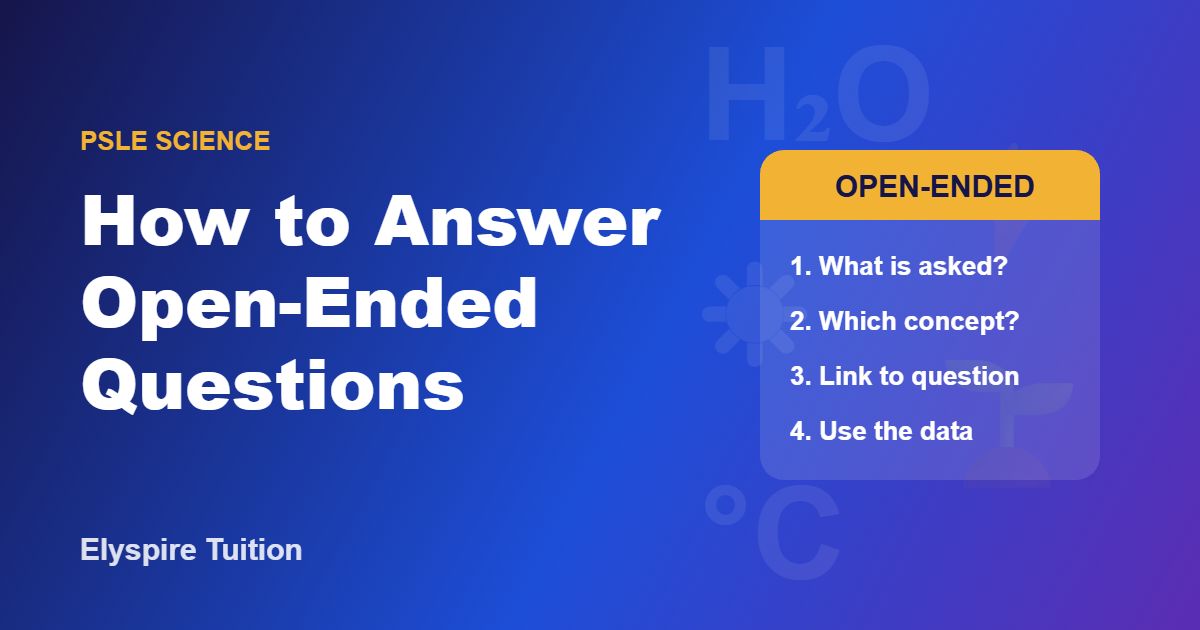
A reliable routine helps. First, read the question and underline what it asks: explain, compare, predict or suggest. Second, identify which topic and concept the question is testing. Third, write the answer so that it states the concept and links it directly to the situation described.
For example, an answer about a melting ice cube should not only say that heat is gained. It should say where the heat comes from, what the ice gains it from, and what happens to the ice as a result, using the objects named in the question.
Using Keywords Without Losing Meaning

Scientific keywords matter, because they show the examiner that your child knows the precise concept. Words such as “gains heat”, “evaporates”, “conductor of heat” and “exerts a force” are more accurate than everyday phrases.
Keywords work only in a complete explanation, though. A list of correct terms that does not link to the question rarely earns full marks, so practise writing one or two full sentences that connect each keyword to the situation.
Reading Data, Graphs and Tables
Many Booklet B questions include a table, graph or diagram. Your child should describe the trend in words, quote the relevant figures, and then explain the trend using a science concept.
Common slips include reading the wrong axis, ignoring units and describing only part of a trend. A quick habit of tracing the graph with a finger and checking the units before writing prevents many of these.
Experiment Questions: Variables and Fair Tests

Experiment questions ask about the aim of an experiment, the variable being changed, the variables kept the same and how results are measured. Your child should be able to name each of these clearly for any set-up shown.
Questions often ask why a step is needed, such as repeating the experiment or using identical containers. Practising short answers to “why” questions about fair tests builds confidence for these marks.
Common Ways Marks Are Lost
Marks are often lost in predictable ways: answering a different question from the one asked, giving a general fact without linking it to the situation, leaving out the cause or the effect in an explanation, and not using the data provided.
Reviewing marked school papers with these patterns in mind is one of the most useful things a family can do. Sorting lost marks by type shows whether the gap is in content, in application or in how answers are written.
A Revision Routine for Primary 5 and 6
Short, regular practice works best. Revising one topic a week, doing a few open-ended questions on it, and checking each answer against the question asked builds steady progress through Primary 5 and Primary 6.
A personal “keyword and concept” notebook helps too, with each topic’s key ideas written in your child’s own words. Signs that extra support would help include strong multiple-choice marks but weak Booklet B marks, or answers that are often marked “incomplete”.
How Elyspire Tuition Supports PSLE Science Students
At Elyspire Tuition, our certified, experienced and patient tutors teach one-to-one, at home or online, from Primary through Secondary. For PSLE Science, we focus on clear explanations of each concept, systematic practice with open-ended questions and patient guidance, and we track each student’s progress across the year.
Our PSLE Science tuition prepares students for both booklets, and our Primary Science tuition builds the foundations in earlier years. WhatsApp us at +65 9684 2263 to talk about your child’s needs and find a tutor who suits them.
Frequently Asked Questions

How long is the PSLE Science paper?
The 2026 PSLE Science paper is one written paper of 1 hour 45 minutes, with Booklet A and Booklet B.
How many marks are open-ended questions worth in PSLE Science?
Booklet B has 10 to 11 structured questions worth 2, 3, 4 or 5 marks each, for 40 marks out of 100.
How many multiple-choice questions are in PSLE Science?
Booklet A has 30 multiple-choice questions with four options, each worth 2 marks, for 60 marks.
Which syllabus does the 2026 PSLE Science paper follow?
SEAB states that the paper assesses the 2023 Primary Science syllabus.