




Sec 1 Math: A December Holiday Plan for Parents
After PSLE, most families want a well-earned break, and they should have one. Many parents also ask how much Sec 1 Math their child should look at before January. This guide sets out what Secondary 1 Mathematics covers, the topics that feel new to most students, and a light four-week plan for the December holidays that keeps rest at the centre.

Sec 1 Math starts with numbers (primes, HCF and LCM, negative numbers) and then moves quickly into algebra and linear equations in Term 1. A light holiday plan of 20 to 30 minutes a day in the last three weeks of December, focused on negative numbers and simple algebra, helps most students start Secondary 1 with confidence. Elyspire Tuition offers one-to-one Secondary Maths tuition at home or online in Singapore.
What Sec 1 Math Covers in the First Term
Secondary schools set their own schemes of work under the national syllabus, so the order differs a little from school to school. As one example, Yishun Secondary School’s 2026 Sec 1 G3 content outline begins Term 1 with prime numbers, square roots and cube roots, HCF and LCM, negative numbers, fractions and decimals, rounding and estimation.
The same Term 1 then introduces algebra: notation, simplifying linear terms, expanding and factorising linear expressions, and solving linear equations. By the first Weighted Assessment, usually in the last weeks of Term 1, students are working with letters as well as numbers.
The Topics That Feel New to Most Students
Primary Mathematics already includes simple algebra, ratio and percentage, so a good part of Sec 1 Math builds on familiar ground. Three ideas tend to feel new.
Negative numbers come first. Students learn to add, subtract, multiply and divide with them, and later use them in algebra and on graphs. Algebraic manipulation comes next: expanding brackets, collecting like terms and solving equations with fractions. Then, later in the year, coordinates, functions and linear graphs connect algebra to pictures.
Sec 1 Math Topics Across the Year
In the Yishun Secondary outline, Term 2 covers linear equations in real-world contexts, formulae, number patterns, percentage (including percentage change and reverse percentage), ratio, rate and speed, and basic geometry. Term 3 covers angles with parallel lines, triangles, quadrilaterals and polygons, statistics, coordinates and linear graphs, and perimeter and area. Term 4 completes volume and surface area of prisms, cylinders and composite solids before the End-of-Year Examination.
Your child’s school will share its own plan in January, often on the school website or in the first Mathematics lesson.
Rest First: Planning the Weeks After PSLE

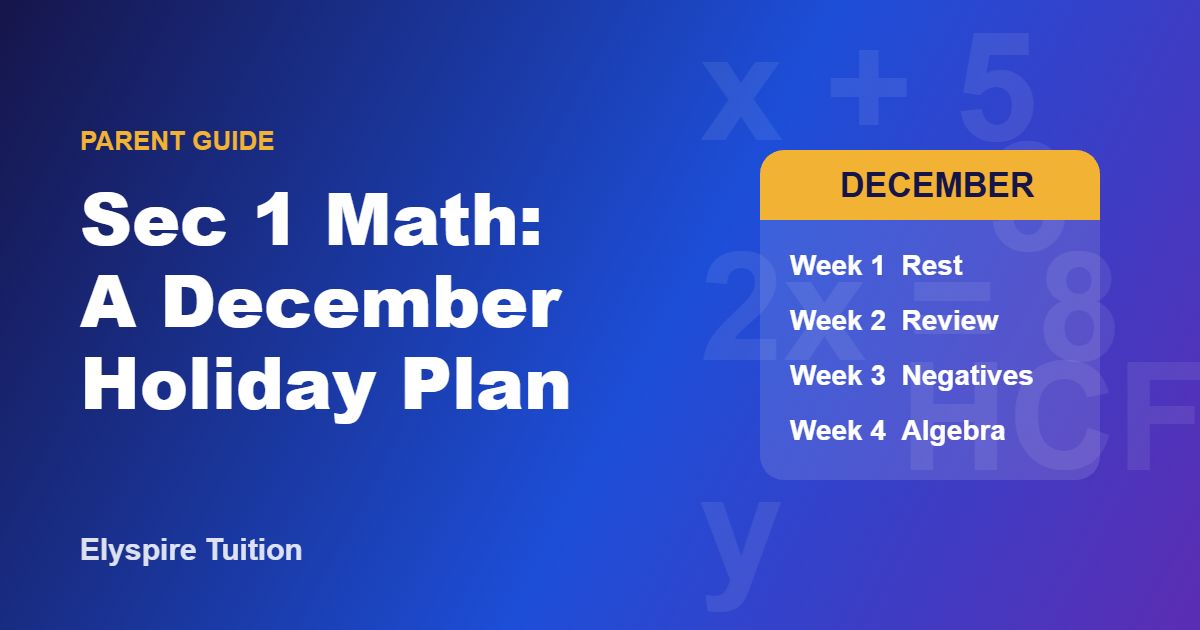
The weeks after PSLE are a real break, and a rested child learns faster in January. S1 Posting results are expected on Friday 18 December 2026 (tentative), so the first half of December is a good time for family time, reading for pleasure, sport and sleep.
A useful rule of thumb is to keep Sec 1 Math preparation to the last three weeks of the holidays and to short sessions. Twenty to thirty minutes a day is enough to build familiarity without turning the holidays into another exam year.
Weeks 1 and 2: Rest, Then Review the Primary Base
Week 1 is rest. No formal Mathematics, but plenty of everyday number sense: shopping change, cooking measures and travel times.
Week 2 reviews the Primary base. Fractions, decimals, percentage and ratio carry straight into Sec 1 Math, so a few PSLE-style questions on each topic show where a refresher helps.
Weeks 3 and 4: Negative Numbers and Simple Algebra

Week 3 introduces negative numbers. A number line on paper, a thermometer or a lift with basement floors makes the rules for adding and subtracting easy to picture.
Week 4 starts simple algebra. Practise writing expressions from words (“5 more than a number”), simplifying like terms and solving one-step and two-step equations. Stop there; brackets and factorising are best learnt with the teacher in Term 1.
Building Study Habits for Secondary School
Secondary school brings more subjects, a longer day and Co-Curricular Activities, so habits matter as much as content. Show working on every step, because method marks matter in Secondary Mathematics. Keep one notebook for mistakes and the corrected method. Review the day’s lesson for ten minutes on the same evening, while it is fresh.
Students also start using a scientific calculator in Secondary school, so a few minutes learning its fraction and negative-number keys in December saves time in class.
Signs Your Child May Need Extra Support
Most students settle into Sec 1 Math within the first term. A few signs suggest that extra support would help: marks in the first Weighted Assessment well below Primary results, confusion with negative signs in algebra, skipped working, or a child who avoids Mathematics homework.
Early help works best. A short gap in Term 1 algebra is far easier to close than one discovered after the End-of-Year Examination, because later topics such as linear graphs build on it.
How Elyspire Tuition Supports Secondary 1 Students
At Elyspire Tuition, our certified, experienced and patient tutors teach one-to-one, at home or online, from Primary through Secondary. For Sec 1 Math, we focus on clear explanations of each new idea, steady practice and patient guidance, and we track each student’s progress across the term.
Our Secondary Maths tuition follows your child’s school scheme of work, and our Secondary tuition covers other subjects too. WhatsApp us at +65 9684 2263 to talk about your child’s needs and find a tutor who suits them.
Frequently Asked Questions

Is Sec 1 Math much harder than PSLE Math?
The pace is faster and algebra becomes central, but much of Sec 1 Math builds on Primary topics such as fractions, percentage and ratio. Students who are steady with these and comfortable with negative numbers usually adjust within the first term.
Should my child study Sec 1 Math before school starts?
A light start helps. Twenty to thirty minutes a day in the last three weeks of December, on negative numbers and simple algebra, builds familiarity without taking away the rest children need after PSLE.
What is G3 Mathematics?
Under Full Subject-Based Banding, subjects are offered at G1, G2 and G3 levels, and G3 is the most demanding. Students in Posting Group 3, and others with strong Mathematics results, take G3 Mathematics from Secondary 1.
When is the first Sec 1 Math test?
Each school sets its own calendar. In many schools the first Weighted Assessment falls near the end of Term 1, after negative numbers and the first algebra topics.