

PSLE Oral: How to Prepare for the English Oral Exam
The PSLE oral is the part of the English examination many children feel least sure about, yet it carries a fifth of the English grade. The good news is that oral skills grow steadily with short, regular practice at home. This guide explains how the PSLE English oral is set out, what each part asks of your child, and simple ways to prepare over the coming year.
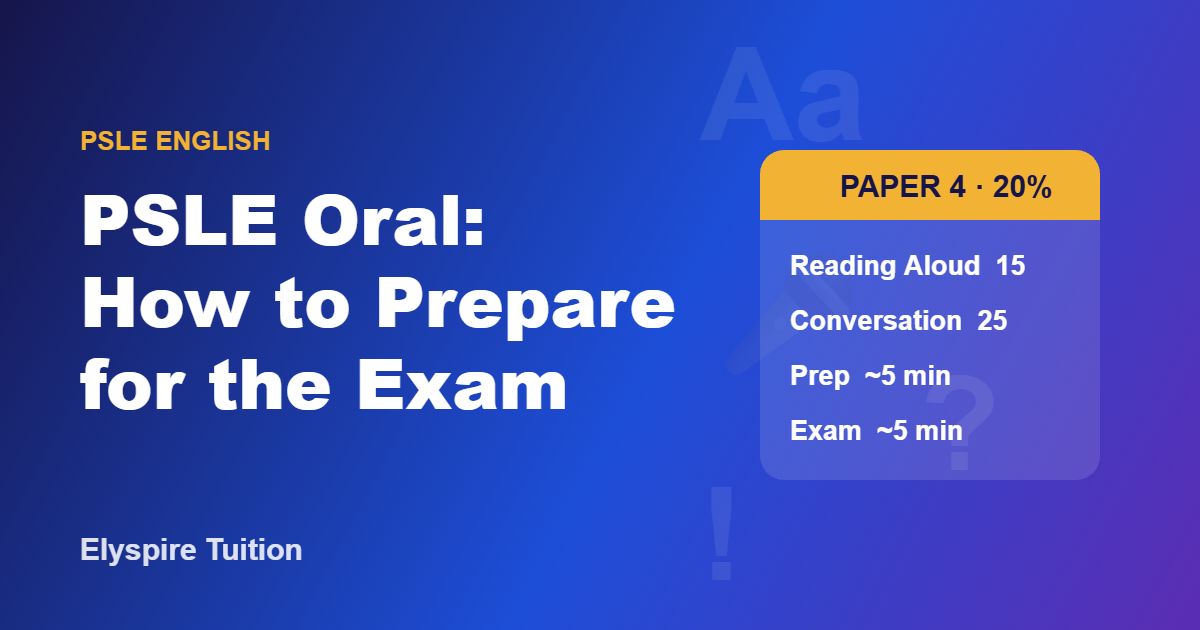
The PSLE oral (Paper 4) is worth 20% of the English Language grade. It has two parts: Reading Aloud, worth 15 marks, and a Stimulus-based Conversation about a photo, worth 25 marks, with about 5 minutes to prepare and about 5 minutes in the examination. Short daily reading aloud and family conversations about pictures build both skills. Elyspire Tuition offers one-to-one PSLE English tuition at home or online in Singapore.
How the PSLE Oral Exam Is Set Out
Under the SEAB PSLE English Language syllabus for 2026, Paper 4 (Oral Communication) makes up 20% of the English Language grade. It has two parts: Reading Aloud a passage, worth 15 marks, and a Stimulus-based Conversation based on one photo, worth 25 marks.
The oral takes about 10 minutes in all: about 5 minutes of preparation time and about 5 minutes in the examination itself. Because it is held separately from the written papers, it is easy to leave preparation too late.
What the Two Parts Ask of Your Child
Reading Aloud asks your child to read a text to suit the purpose, audience and context of a given situation. SEAB’s first oral objective is to read aloud fluently and expressively, with clear and accurate pronunciation.
The Stimulus-based Conversation is a conversation with the examiners on a topic based on a photo, and the two parts are not linked by theme. SEAB looks for personal opinions, ideas and experiences expressed clearly to engage the listener, and for fluent speech with clear pronunciation, accurate grammar and a range of vocabulary. This part rewards a child who can explain and give examples, not only describe what they see.

Using the Preparation Time Well
The preparation time is short, so a routine helps. For the passage, your child can read it through silently once for meaning, then mark where the tricky words and natural pauses are.
For the photo, a good habit is to notice what is happening, how the people might feel, and what it reminds your child of in their own life. Those three ideas give a ready starting point for the conversation.
Reading Aloud With Confidence

Good reading aloud is steady rather than fast. Pausing at full stops and commas, stressing important words, and changing tone for questions, dialogue and exclamations all help the listener follow the passage.
Accurate pronunciation matters, especially for word endings such as “-ed” and “-s”, and for longer words. If a word is unfamiliar, it is better to read on calmly than to stop and restart.
Building a Strong Conversation
Strong answers usually follow a simple pattern: give a clear point, explain it, and add an example from personal experience or something your child has read or seen. This turns a one-line answer into a real conversation.
Your child should also listen carefully to each question and answer that question, rather than a prepared one. It is fine to take a moment to think, and polite phrases such as “That’s an interesting question” give useful thinking time.
Daily Habits That Build Oral Skills

Reading aloud for five to ten minutes a day, from storybooks, news articles for children or school readers, builds fluency and confidence. Recording a reading and listening back helps your child hear their own pace and expression.
Conversation practice can happen anywhere. Asking your child for their opinion on a photo in the newspaper, a family outing or a news story, and gently asking “why?” and “can you give an example?”, builds the same skills the examiners look for.
Common Oral Slips to Avoid
Common slips include reading too quickly, mumbling the ends of words, giving one-word answers, and describing the photo without sharing any personal view. Nerves often make these worse, which is why regular practice in a calm setting matters.
Another slip is memorising long model answers. Examiners respond to what your child actually says, so a natural, well-explained answer usually serves better than a recited one.
Planning Oral Practice Through Primary 5 and 6
Oral skills build slowly, so the most useful plan spreads practice across the year rather than cramming in the weeks before the examination. A little reading aloud each day and one conversation practice each week through Primary 5 and Primary 6 is a realistic rhythm.
Signs that extra support would help include a child who reads haltingly, avoids speaking up in class, or gives very short answers even on familiar topics. Starting early gives confidence time to grow.
How Elyspire Tuition Supports PSLE English Students
At Elyspire Tuition, our certified, experienced and patient tutors teach one-to-one, at home or online, from Primary through Secondary. For the PSLE oral, one-to-one lessons give your child regular, low-pressure speaking practice, with clear explanations, systematic practice and patient feedback on reading and conversation, and we track each student’s progress across the year.
Our PSLE English tuition covers oral, writing and comprehension, and our guide to the PSLE English composition explains the writing paper. WhatsApp us at +65 9684 2263 to talk about your child’s needs and find a tutor who suits them.
Frequently Asked Questions

How many marks is the PSLE English oral worth?
The oral (Paper 4) is worth 40 marks and makes up 20% of the English Language grade: 15 marks for Reading Aloud and 25 marks for the Stimulus-based Conversation.
How long is the PSLE English oral?
About 10 minutes in all, with about 5 minutes of preparation time and about 5 minutes in the examination.
What is the Stimulus-based Conversation?
It is a conversation with the examiners on a topic based on one photo. Your child shares personal opinions, ideas and experiences in response to their questions.
How can my child practise for the PSLE oral at home?
Reading aloud for five to ten minutes a day and talking about photos and everyday events, with follow-up “why” questions, build both parts of the oral.