




Sec 1 Science: What Changes From Primary Science
Many students enjoy Primary Science and then find Sec 1 Science surprisingly different. The topics go deeper, the ideas become more abstract, and practical work in the laboratory becomes a regular part of lessons. This guide shows how Sec 1 Science is typically organised, what feels new, and simple ways to help your child start the year well.

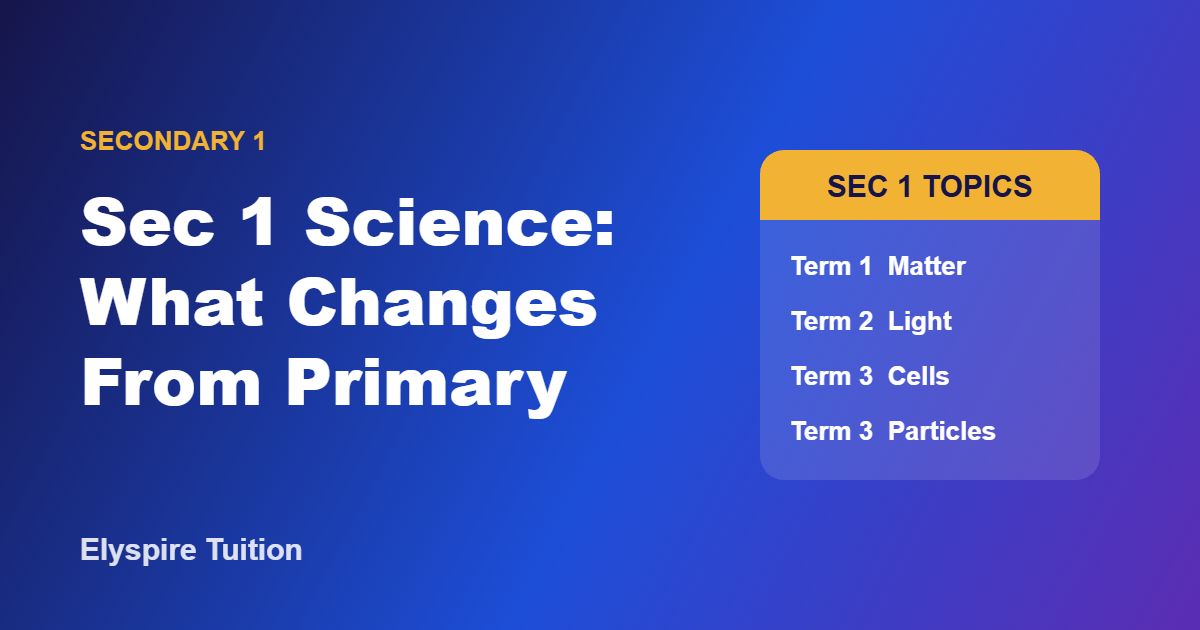
Sec 1 Science builds on Primary Science but moves to more abstract models, such as particles, atoms and cells, and adds regular laboratory work. In one school’s 2026 outline, Term 1 covers the scientific endeavour and the diversity of matter, and later terms cover separation techniques, light, cells and the particulate nature of matter. Elyspire Tuition offers one-to-one Secondary Science tuition at home or online in Singapore.
How Sec 1 Science Is Organised
Secondary schools plan their own schemes of work under the national Lower Secondary Science syllabus, so the order of topics differs a little between schools. Your child’s school usually shares its plan at the start of the year.
As one example, Yishun Secondary School’s 2026 Sec 1 Lower Secondary Science outline for G2 and G3 classes runs through eight chapters across the year, with a Weighted Assessment in each of the first three terms and an End-of-Year Examination in Term 4.
Term 1: The Scientific Endeavour and Matter
In that outline, Term 1 opens with The Scientific Endeavour, which introduces how scientists ask questions, investigate and work safely. It then moves to exploring the diversity of matter by its physical properties and by its chemical properties.
Term 1 ends with the start of separation techniques, the methods used to separate mixtures. The first Weighted Assessment, in Week 8 of Term 1, covers the first three chapters.
What Feels New Compared With Primary Science
The biggest change is the use of models. Instead of describing what can be seen, students learn to explain it with ideas such as particles, atoms, molecules and cells, which cannot be seen directly.
The pace and the vocabulary change too. Each chapter introduces precise scientific terms, and questions ask students to explain why something happens, not only what happens.
Terms 2 and 3: Light, Cells and Particles

In the same outline, Term 2 completes separation techniques and introduces the ray model of light. Term 3 covers the model of cells as the basic units of life, and then the model of matter: the particulate nature of matter, atoms and molecules.
Term 4 is for revision and the End-of-Year Examination, which covers all eight chapters. Because later chapters build on earlier ones, steady understanding through the year matters more than a last-minute push.
Lab Skills and Practical Work
Laboratory work becomes a regular part of Sec 1 Science. Students learn to handle apparatus safely, follow procedures, record observations and present results in tables and graphs.
These skills are assessed as well as taught. A student who reads the procedure carefully, records results neatly and explains what the results show is building habits that carry into Upper Secondary Science.
Writing Science Answers in Secondary School

Secondary Science answers need to be precise. A good answer names the scientific concept, applies it to the situation in the question, and uses the correct terms, rather than everyday words.
Practising short explanations helps a great deal. After each lesson, asking your child to explain one idea in two or three sentences, using the new terms, builds the habit early in the year.
A Light Start Before January
The December holidays are mainly for rest after the PSLE. In the last weeks, a light start helps: reading about everyday science, revisiting Primary topics such as matter and light, and getting comfortable with a few new terms.
Many families plan Mathematics and Science together. Our guide to Sec 1 Math over the December holidays suggests a similar light, week-by-week approach.
Signs Your Child May Need Extra Support
Most students settle into Sec 1 Science within the first term. Signs that extra support would help include confusion between particles, atoms and molecules, answers that describe but do not explain, or first Weighted Assessment marks well below Primary Science results.
Early help works best. The models introduced in Sec 1 return throughout Secondary Science, so a clear understanding now makes Physics, Chemistry and Biology easier later.
How Elyspire Tuition Supports Secondary Science Students
At Elyspire Tuition, our certified, experienced and patient tutors teach one-to-one, at home or online, from Primary through Secondary. For Sec 1 Science, we focus on clear explanations of each new model, systematic practice with answer writing and patient guidance, and we track each student’s progress across the year.
Our Secondary Science tuition follows your child’s school scheme of work, and our Secondary tuition covers other subjects too. WhatsApp us at +65 9684 2263 to talk about your child’s needs and find a tutor who suits them.
Frequently Asked Questions

What topics are in Sec 1 Science?
Schools plan their own order. In one school’s 2026 Sec 1 G2/G3 outline, the eight chapters are the scientific endeavour, matter by physical and chemical properties, separation techniques, the ray model of light, cells, and the particulate nature of matter, atoms and molecules.
Is Sec 1 Science harder than Primary Science?
It is more abstract. Students explain observations with models such as particles, atoms and cells, use more precise terms and do regular laboratory work.
When is the first Sec 1 Science test?
Each school sets its own calendar. In the outline above, the first Weighted Assessment is in Week 8 of Term 1 and covers the first three chapters.
How can my child prepare for Sec 1 Science?
Rest first after the PSLE, then a light start in the last weeks of the holidays: reading about everyday science and revisiting Primary topics such as matter and light.