




PSLE AL Score Explained: A Parent's Guide for 2026
Your child’s PSLE AL score sets the Posting Group and the starting subject levels for Secondary 1. With results day close, this guide explains each Achievement Level, how the four levels add up to the PSLE Score, and what the total means for your school choices.

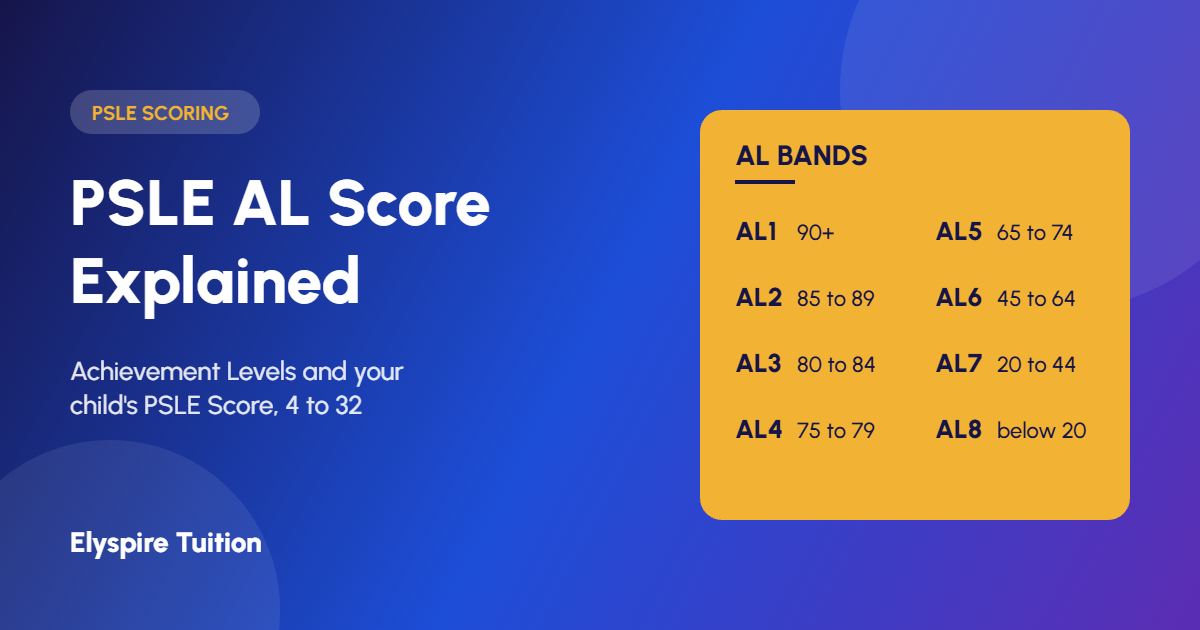
The PSLE AL score grades each of the four PSLE subjects from AL1 (90 marks and above) to AL8 (below 20 marks), and the four levels add up to a PSLE Score from 4 to 32, where 4 is the best. In Singapore, that total places your child in Posting Group 1, 2 or 3 for Secondary 1. At Elyspire Tuition, our one-to-one tutors use it to plan a confident start to secondary school.
What the PSLE AL Score Means
Since the 2021 PSLE, each subject is scored using eight Achievement Levels, with AL1 the best. The four subjects are English, Mathematics, Science and Mother Tongue. Standard subjects are graded from AL1 to AL8, and Foundation subjects from AL A to AL C.
An AL reflects your child’s own level of achievement, measured against what the curriculum sets out to teach. MOE explains that ALs show a child’s level of achievement, whatever their classmates score. Children who perform similarly share the same band, so a single mark carries less weight than it did under the T-score.
Mark Ranges for AL1 to AL8
MOE’s PSLE Score Calculator lists the mark range for each Standard level AL:
- AL1: 90 marks and above
- AL2: 85 to 89 marks
- AL3: 80 to 84 marks
- AL4: 75 to 79 marks
- AL5: 65 to 74 marks
- AL6: 45 to 64 marks
- AL7: 20 to 44 marks
- AL8: below 20 marks
The top four bands are each five marks wide, while AL5 to AL7 cover wider ranges. MOE explains that the upper bands are narrower because slightly less than half of the cohort is expected to score AL1 to AL4 in Standard subjects.

How the Four ALs Add Up to Your Child's PSLE Score
Your child’s PSLE Score is the sum of the four subject ALs, so it runs from 4 to 32, with 4 the best possible total (MOE). MOE’s own example: AL3 in English, AL2 in Mother Tongue, AL1 in Mathematics and AL2 in Science give a PSLE Score of 8.
Each subject counts equally towards the total. Moving up one band in any subject improves the score by one point, so steady work across all four subjects matters more than chasing a single top grade.
Foundation Subjects: AL A to AL C

Children taking a Foundation subject receive AL A, AL B or AL C. For Secondary 1 posting, MOE maps these to Standard level ALs: AL A (75 to 100 marks) counts as AL6, AL B (30 to 74 marks) as AL7 and AL C (below 30 marks) as AL8.
Your child’s PSLE Score then adds these equivalents to the ALs of the Standard subjects, in the same way as for any other child.
PSLE AL Score and Posting Groups 1, 2 and 3
From the 2024 Secondary 1 cohort, the Express, Normal (Academic) and Normal (Technical) streams made way for three Posting Groups under Full Subject-Based Banding. MOE sets out how each PSLE Score maps to a group:
- PSLE Score 4 to 20: Posting Group 3, most subjects at G3
- PSLE Score 21 and 22: Posting Group 2 or 3
- PSLE Score 23 and 24: Posting Group 2, most subjects at G2
- PSLE Score 25: Posting Group 1 or 2
- PSLE Score 26 to 30, with AL7 or better in English and Mathematics: Posting Group 1, most subjects at G1
G stands for General, and G3 is the most demanding level. Posting Groups are used for school admission and to guide the starting subject levels; once in school, children learn in mixed form classes with classmates from every group.
Taking Stronger Subjects at a Higher Level in Secondary 1

A strong AL in one subject can open a more demanding level for that subject. In MOE’s example, a child with a PSLE Score of 23 and AL5 in Mathematics enters through Posting Group 2, takes most subjects at G2 and can take Mathematics at G3.
Children posted through Posting Groups 1 and 2 may take English, Mathematics, Science and Mother Tongue at a more demanding level when they did well in those subjects at the PSLE (MOE). Our Secondary 1 Maths holiday plan and Secondary 1 Science guide show how to prepare for the first term.
How Cut-Off Points and Tie-Breakers Work
A school’s cut-off point is the PSLE Score of the last student admitted through each Posting Group the year before. SchoolFinder lists these score ranges as a reference, and the current year’s ranges are set only after posting ends.
When two children share the same PSLE Score, school choice order acts as a tie-breaker: the child who listed the school higher has priority. MOE reports that in the 2022 posting, most tie-breaks were settled by citizenship and choice order, with computerised balloting also part of the process. List your six schools in your true order of preference.
Higher Mother Tongue After the PSLE
Higher Mother Tongue now depends on the Mother Tongue result itself. From the 2026 Secondary 1 cohort, children with AL1 or AL2 in Mother Tongue, or a Distinction or Merit in Higher Mother Tongue, may take Higher Mother Tongue at the start of Secondary 1, whatever their overall PSLE Score (MOE).
If your child enjoys their Mother Tongue and meets these criteria, it is worth talking to the secondary school about Higher Mother Tongue during orientation.
How Elyspire Tuition Supports Secondary 1 Students
We offer one-to-one private tuition in Singapore for Primary and Secondary students, with certified, experienced and patient tutors. Each lesson pairs clear explanations with systematic practice, and our tutors monitor and track every student’s progress through the year.
Once you know your child’s PSLE AL score and Posting Group, the December holidays are a good time to build up the subjects that need the most care before January. Read our guide to what to do after the PSLE results, then WhatsApp us to plan a calm start to Secondary 1.
Frequently Asked Questions

When will the 2026 PSLE results be released?
SEAB lists Tuesday 24 November to Wednesday 25 November 2026 as the tentative window, and MOE says results are released at 11am. The exact date is announced through the media once every process is complete.
How many secondary schools can we choose after the results?
You can submit up to six school choices through the S1 Portal, from 11.30am on results day, over 7 calendar days. MOE lists Friday 18 December 2026 as the tentative date for posting results, sent by S1 Portal and SMS.
Is the PSLE AL score the same as the old T-score?
The PSLE Score replaced the T-score from the 2021 PSLE. There are 29 possible PSLE Scores, so children are grouped in wider bands and more schools share the same cut-off points.
Can my child take a subject at a less demanding level?
In some cases, yes. MOE notes that students may have the flexibility to take some subjects at a less demanding level from Secondary 1, so the level suits how they learn. Talk to the school’s teachers early in Term 1.
Can my child change subject levels after Secondary 1?
Yes. Under Full Subject-Based Banding, students can adjust their subject levels at suitable points in secondary school, and choose upper secondary subjects, including electives, at the end of Secondary 2, based on their strengths and interests.